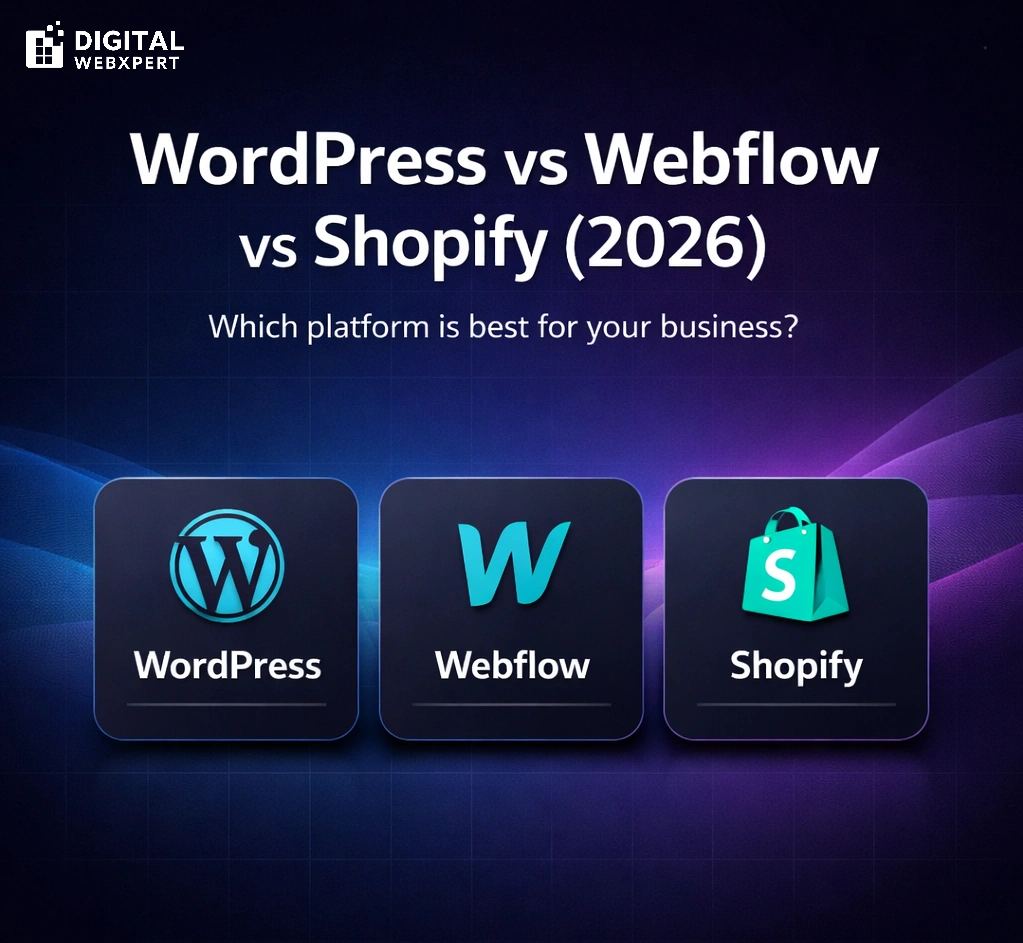
WordPress vs Webflow vs Shopify is one of the biggest “right platform” decisions in 2026. The best choice depends on what you’re building: a content-heavy website, a design-led marketing site, or a serious ecommerce store.
In this guide, we’ll compare all three platforms with a simple decision framework, so you can choose the best fit for your goals, budget, and team.
Quick answer (best platform by goal)
- Choose Shopify if ecommerce is your main business and you want the smoothest, managed store experience.
- Choose Webflow if you want a beautiful, high-converting marketing website with strong design control and managed hosting.
- Choose WordPress if you want maximum flexibility, ownership, and long-term content + SEO growth.
If you want help selecting and building the right platform, explore our web design & development services or request a quote here: Get Free Quote.
WordPress vs Webflow vs Shopify (2026) comparison
- WordPress: Best for content + SEO, custom functionality, and total ownership (you choose hosting and plugins).
- Webflow: Best for design-first marketing sites and fast iteration with managed hosting.
- Shopify: Best for ecommerce-first brands that want reliable checkout, apps, and low maintenance.
How to choose the best platform in 2026 (5 questions)
1) Is ecommerce your main revenue driver?
- Yes → Shopify (fastest path to a store that runs reliably)
- Some products + marketing matters → Webflow or WordPress
- No → WordPress or Webflow
2) Do you need full ownership and deep customization?
- Yes → WordPress (open-source, flexible, plugin ecosystem)
- No, I want managed setup → Webflow or Shopify
3) How important is pixel-perfect design and conversion pages?
- Very important → Webflow
- Important but themes are fine → Shopify
- Flexible approach → WordPress
4) Do you want low maintenance?
- Lowest maintenance → Shopify
- Low maintenance → Webflow
- Higher maintenance (unless managed) → WordPress
5) What team do you have?
- Non-technical team → Shopify/Webflow
- Marketing team + designer → Webflow
- Developer/agency support → WordPress
WordPress in 2026: pros, cons, and best use cases
In the WordPress vs Webflow vs Shopify debate, WordPress usually wins on flexibility and long-term content growth.
WordPress is best for:
- Blogs and content marketing (SEO growth engine)
- Service businesses that need strong landing pages + content hubs
- Custom features (membership, portals, booking, complex workflows)
- Businesses that want platform ownership (open-source)
Pros of WordPress
- Extreme flexibility: plugins, themes, custom development
- Content + SEO powerhouse: ideal for scalable content strategies
- Ownership: you control hosting, data, and roadmap
Cons of WordPress
- Maintenance required: updates, backups, security hardening
- Performance depends on your setup: hosting + optimization
- Plugin/theme quality varies: wrong choices can slow the site
Helpful reference: WordPress is open-source and maintained by a large global community. Learn more here:
About WordPress.
If your goal is a conversion-first WordPress site, we can help with strategy + build: AI-Powered Web Design Services.
Webflow in 2026: pros, cons, and best use cases
Webflow is often the best choice when your website is a “sales machine” built on design and conversion pages.
Webflow is best for:
- High-converting marketing websites
- Startups and service businesses that care about brand + UX
- Landing pages and campaigns that need rapid iteration
- Teams that want managed hosting and less backend hassle
Pros of Webflow
- Best-in-class visual control for modern UI/UX
- Managed hosting (less maintenance vs WordPress)
- Clean editing workflow for marketing teams
Cons of Webflow
- Platform lock-in: migrating later can be more complex
- Ecommerce is good, but not Shopify-level for large catalogs and app ecosystem
- Cost scaling: can rise with seats/features/plans
Helpful reference: Webflow hosting features overview:
Webflow Hosting.
Shopify in 2026: pros, cons, and best use cases
If ecommerce is the core of your business, Shopify is often the safest and fastest path to a scalable store.
Shopify is best for:
- Ecommerce-first brands (DTC, niche products, multi-product catalogs)
- Founders who want to focus on sales, not tech maintenance
- Stores that need apps, integrations, and reliable checkout performance
Pros of Shopify
- Fastest setup for a serious online store
- Massive app ecosystem for growth features
- Managed security + updates (low maintenance)
Cons of Shopify
- Monthly costs add up (plus paid apps)
- Customization limits vs fully custom builds
- Less ownership compared to self-hosted WordPress
Helpful reference: Shopify plans and pricing:
Shopify Pricing.
If you’re building an ecommerce website and want expert guidance, see our ecommerce services:
Ecommerce Solutions.
Best platform by business type (2026)
If you’re a service business (agency, consultant, local services)
- Best pick: WordPress or Webflow
- Choose WordPress if content + SEO is your growth engine
- Choose Webflow if design + conversion pages are priority
If you’re a startup (SaaS, B2B)
- Best pick: Webflow for marketing site + landing pages
- Pair it with CRM + automation for lead handling
If you’re ecommerce-first
- Best pick: Shopify
- Consider Webflow only if design is your biggest differentiator and ecommerce needs are moderate
If you’re a content brand (blog/media/community)
- Best pick: WordPress
- Best for structured content, scaling SEO, and long-term portability
SEO note: which one ranks best?
All three platforms can rank well. SEO is more about:
- site speed and technical setup
- content quality and relevance
- internal linking and site structure
- on-page optimization and consistent publishing
If you want an SEO-first build, start here: Digital WebXpert Services.
Final verdict: WordPress vs Webflow vs Shopify — what should you choose?
- Choose WordPress if you want maximum flexibility, strong content SEO, and full ownership.
- Choose Webflow if you want a premium marketing website with top-tier design control and managed hosting.
- Choose Shopify if ecommerce is your main business and you want the smoothest store setup with strong app support.
If you want a quick recommendation based on your business goals, contact us here:
Contact Digital WebXpert
FAQs
Is Webflow better than WordPress in 2026?
Webflow can be better for design-led marketing sites where you want fast iteration and managed hosting. WordPress is better when you need deep flexibility, content scale, or complex functionality.
Is Shopify better than WordPress for ecommerce?
For most ecommerce-first businesses, Shopify is easier to run and maintain. WordPress + WooCommerce can be powerful, but it usually requires more setup and ongoing maintenance.
Can Digital WebXpert build any of these platforms?
Yes. We help businesses choose the right platform and launch conversion-focused websites and stores. Start here:
Services.