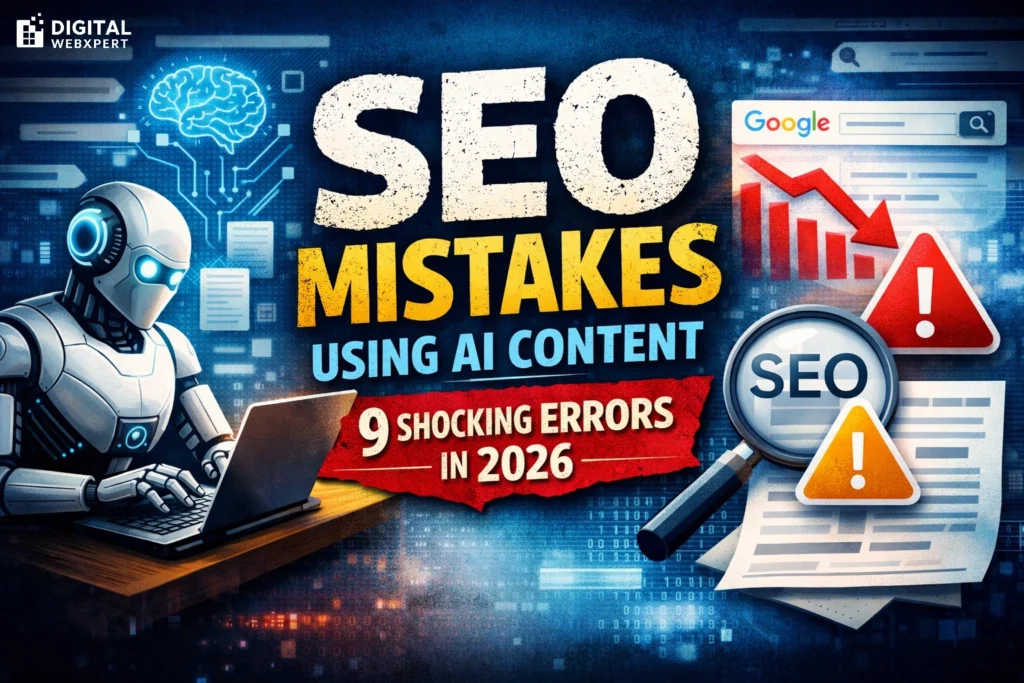
SEO mistakes using AI content are becoming one of the biggest reasons businesses lose rankings in 2026. While AI tools can help scale content production faster than ever, using them without strategy, experience, and human oversight often leads to poor engagement, declining visibility, and long-term SEO damage.
Many businesses assume that because AI can generate content quickly, it must also generate results automatically. Unfortunately, that mindset is exactly what causes SEO failure.
Search engines like Google are smarter than ever. They evaluate content based on usefulness, originality, experience, and trust—not speed or volume.
In this guide, you’ll learn 9 shocking SEO mistakes using AI content, why they hurt rankings, and exactly how to fix them the right way in 2026.
Why SEO Mistakes Using AI Content Are Increasing in 2026
AI tools have lowered the barrier to content creation—but they’ve also increased the risk of low-quality SEO.
The biggest reason SEO mistakes using AI content are increasing is simple:
Businesses are prioritizing automation over strategy.
AI can generate text, but it cannot:
- Understand your business goals
- Demonstrate real-world experience
- Make judgment calls
- Build trust
When AI is used without human leadership, SEO quality drops fast.
1. Publishing AI Content Without Human Editing
This is the most common and damaging SEO mistake.
Many businesses generate AI content and publish it exactly as produced.
Why This Hurts SEO
Unedited AI content often:
- Sounds generic
- Lacks experience
- Misses context
- Contains inaccuracies
Google’s Helpful Content system is designed to detect content that doesn’t genuinely help users.
How to Fix It
- Use AI for drafts only
- Add original insights and examples
- Edit for tone, clarity, and accuracy
- Make content brand-specific
Avoiding SEO mistakes using AI content always starts with human editing.
2. Creating AI Content for Keywords Instead of Users
Another major SEO mistake using AI content is writing for keywords instead of real people.
Why This Is a Problem
Keyword-focused AI content often:
- Ignores search intent
- Feels unnatural
- Causes high bounce rates
- Fails to convert
Search engines now evaluate how users interact with content—not just what keywords appear on the page.
How to Fix It
- Identify user intent first
- Answer real questions clearly
- Use keywords naturally
- Focus on solving problems
The goal of SEO is usefulness, not keyword density.
3. Mass-Producing Low-Quality AI Content
Some businesses believe more content equals more traffic.
So they publish hundreds of AI-generated pages with minimal review.
Why This Is Dangerous
Mass AI content leads to:
- Thin pages
- Weak topical authority
- Wasted crawl budget
- Site-wide quality dilution
This is one of the fastest ways to damage long-term SEO.
How to Fix It
- Publish less, but better content
- Focus on depth and completeness
- Audit and remove weak pages
- Build topical authority intentionally
One high-quality article is worth more than ten weak ones.
4. Ignoring EEAT Signals in AI Content
AI cannot demonstrate experience or authority on its own.
Ignoring EEAT is one of the most serious SEO mistakes using AI content.
Why EEAT Matters
Google prioritizes content that shows:
- Experience
- Expertise
- Authority
- Trust
AI lacks lived experience—and search engines can detect that.
How to Fix It
- Add author bios
- Include real examples or case studies
- Share expert insights
- Cite credible sources
AI supports content creation, but humans build trust.
5. Rewriting Competitor Content With AI
Using AI to rewrite competitor pages is a dangerous shortcut.
Why This Hurts SEO
- Creates near-duplicate content
- Adds no original value
- Weakens brand differentiation
- Risks algorithmic devaluation
Google rewards original contribution, not reworded content.
How to Fix It
- Use competitors only for research
- Add new perspectives and depth
- Improve clarity and usefulness
- Answer questions competitors miss
Your content should be better—not similar.
6. Over-Optimizing Content Based on AI Suggestions
AI SEO tools offer optimization recommendations—but blindly following them leads to over-optimization.
Common Over-Optimization Issues
- Keyword repetition
- Forced headings
- Unnatural internal linking
- Content written for tools, not humans
How to Fix It
- Treat AI suggestions as guidance
- Optimize for readability first
- Review content manually
- Focus on natural flow
SEO should feel human, not mechanical.
7. Publishing AI Content Without Fact-Checking
AI can produce confident but incorrect information.
This is especially dangerous for:
- SEO advice
- Marketing strategies
- Technical content
Why Accuracy Matters
Incorrect content:
- Damages trust
- Hurts brand credibility
- Reduces engagement
- Leads to ranking drops
How to Fix It
- Always fact-check AI outputs
- Verify statistics
- Update outdated information
- Use authoritative sources
Accuracy is a core SEO ranking signal.
8. Forgetting to Update AI Content After Publishing
Many businesses treat AI content as “publish and forget.”
That approach no longer works.
Why This Is a Mistake
Search intent evolves. Competitors improve. Algorithms change.
Outdated AI content:
- Loses rankings
- Stops converting
- Becomes irrelevant
How to Fix It
- Review content regularly
- Refresh data and examples
- Improve clarity and structure
- Add FAQs and new insights
SEO is ongoing—not one-time.
9. Treating AI as a Replacement Instead of an Assistant
This mindset causes nearly every SEO mistake using AI content.
Why This Is the Biggest Problem
AI:
- Cannot define strategy
- Lacks judgment
- Cannot understand business context
SEO is a strategic discipline—not a fully automated process.
The Right Approach
- Use AI for speed and scale
- Let humans lead strategy
- Balance automation with experience
- Focus on long-term growth
The future of SEO is human-led and AI-supported.
Common Signs SEO Mistakes Using AI Content Are Hurting Your Site
- Declining organic traffic
- High bounce rates
- Low engagement time
- Ranking volatility
- Generic or repetitive content
These signals indicate AI content needs better oversight.
Best Practices to Avoid SEO Mistakes Using AI Content in 2026
✔ Use AI for research and drafts
✔ Add experience and originality
✔ Focus on user intent
✔ Maintain EEAT signals
✔ Edit and fact-check everything
✔ Update content regularly
This approach aligns perfectly with Google’s Helpful Content guidelines.
❓ Frequently Asked Questions (FAQ)
Is AI-generated content bad for SEO in 2026?
No. AI-generated content is not bad for SEO by default. However, SEO mistakes using AI content, such as publishing unedited drafts or ignoring EEAT signals, can harm rankings. Well-edited, helpful AI content can perform very well.
Can Google detect AI-written content?
Google evaluates content quality, usefulness, and originality—not whether it was written by AI. Low-quality content may be devalued, regardless of how it was created.
What is the biggest SEO mistake with AI content?
The biggest mistake is publishing AI content without human review. AI should assist, not replace, expertise and judgment.
How often should AI content be updated?
AI content should be reviewed regularly, especially if rankings drop or search intent changes. Continuous optimization is essential.
Can AI replace SEO professionals?
No. AI supports SEO professionals but cannot replace strategy, experience, and decision-making.
Final Thoughts: Avoiding SEO Mistakes Using AI Content Is the Key to Growth
SEO mistakes using AI content are not caused by AI itself—they are caused by poor strategy and lack of human oversight.
Businesses that succeed in 2026 will:
- Use AI responsibly
- Prioritize quality over volume
- Build trust and authority
- Focus on real user value
AI is a tool.
SEO success still depends on human expertise, judgment, and experience.