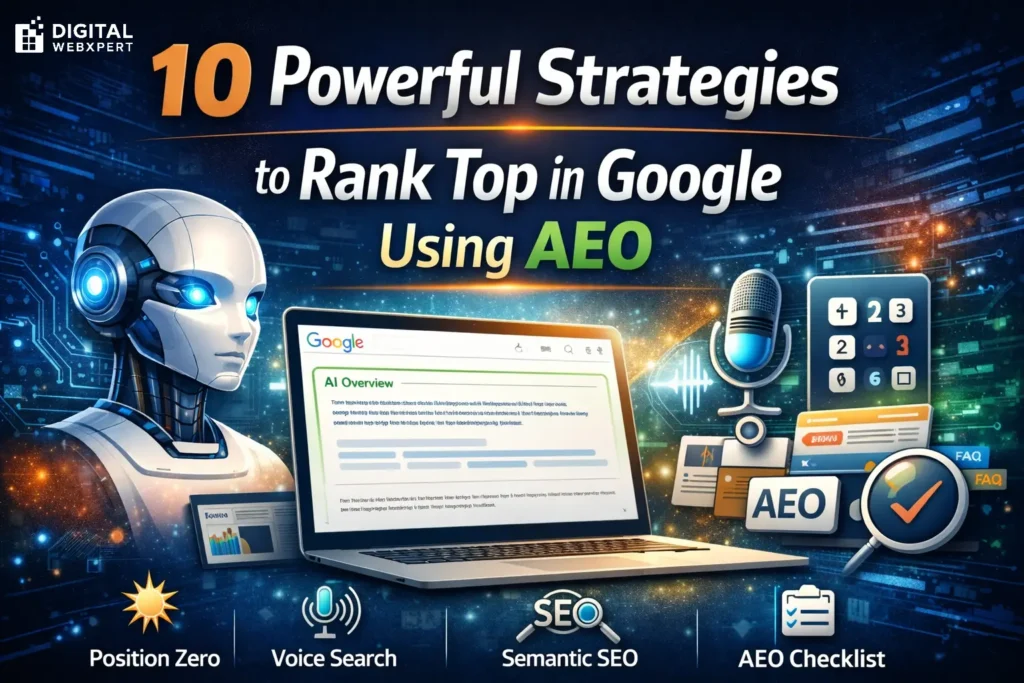
10 Powerful Strategies to Rank Top in Google Using AEO
If you want to rank top in Google using AEO, you need more than traditional SEO.
Search has evolved toward AI-generated answers, featured snippets, and voice results.
AEO (Answer Engine Optimization) helps your content become the answer — not just another blue link.
If you’re still relying only on traditional SEO tactics, review our
SEO mistakes using AI content
to avoid ranking issues.
What Is AEO (Answer Engine Optimization)?
AEO (Answer Engine Optimization) is the process of structuring content so search engines and AI systems can extract direct answers and display them in featured snippets, AI summaries, and voice search results.
According to Google’s official documentation on
featured snippets
, structured answers increase eligibility for Position Zero results.
Why AEO Is Essential to Rank Top in Google Using AEO
Google increasingly provides direct answers through AI Overviews.
If your content is structured clearly, it may be selected as the primary answer.
To fully understand ranking foundations, read our guide on
choosing the right platform for SEO growth
.
- Clear direct answers
- Semantic keyword usage
- Schema markup implementation
- Strong E-E-A-T signals
- Internal linking strategy
1. Target Question-Based Keywords
The foundation to rank top in Google using AEO is targeting real user questions.
Use tools like:
- Google Search Console
- Google Trends
- Google “People Also Ask”
You can also explore our
eCommerce SEO optimization tips
for question-based content ideas.
2. Add Direct 40–60 Word Answers Under Each H2
To rank top in Google using AEO, always provide a concise definition under headings.
Google extracts short structured paragraphs more easily.
Example:
How does AEO improve rankings?
AEO improves rankings by structuring content in a format that search engines can extract for featured snippets, AI Overviews, and voice search results.
3. Optimize for Featured Snippets
Google highlights structured content in Position Zero. Learn more about snippet best practices from
Google’s helpful content guidelines
.
- Keep answers under 60 words
- Use numbered steps
- Add tables when possible
- Use clear H2 & H3 hierarchy
4. Implement Schema Markup
Schema markup increases eligibility for rich results.
Google officially recommends structured data for enhanced search features:
Google Structured Data Guidelines
For WordPress users, the Rank Math plugin makes schema implementation easier. See our complete
Rank Math optimization guide
.
5. Use Semantic SEO & Entity Optimization
To rank top in Google using AEO, your content must demonstrate topic depth.
Google uses Natural Language Processing explained in their
BERT algorithm update
.
- Search engine optimization
- Core Web Vitals
- Technical SEO
- Backlinks
- On-page optimization
6. Strengthen E-E-A-T Signals
Google prioritizes content from trusted sources. Their
Search Quality Rater Guidelines
emphasize Experience, Expertise, Authority, and Trust.
- Add author credentials
- Include case studies
- Show real examples
- Link to authoritative sources
7. Improve Core Web Vitals
Speed affects ranking. Review Google’s official
Core Web Vitals documentation
.
Also check our guide on
platform performance comparisons
to choose a faster infrastructure.
8. Build Topic Clusters
Topical authority improves your ability to rank top in Google using AEO.
Create supporting posts around:
- AEO vs SEO
- AEO checklist
- Voice search optimization
- Google AI Overviews strategy
9. Add an Optimized FAQ Section
Google often pulls answers from FAQ sections. Implement FAQ schema properly to enhance visibility.
10. Optimize for Conversational Search
Voice queries are longer and natural. Structure your content conversationally.
Frequently Asked Questions
Can AEO help rank #1?
Yes. AEO increases the chances of appearing in featured snippets and AI Overviews, often above traditional rankings.
Is AEO replacing SEO?
No. AEO enhances SEO by focusing on answer visibility and structured content.
Final Thoughts
If you want to rank top in Google using AEO, combine structured formatting, schema markup, semantic depth, internal linking, and technical SEO.
Need expert help?
Contact Digital WebXpert
today.