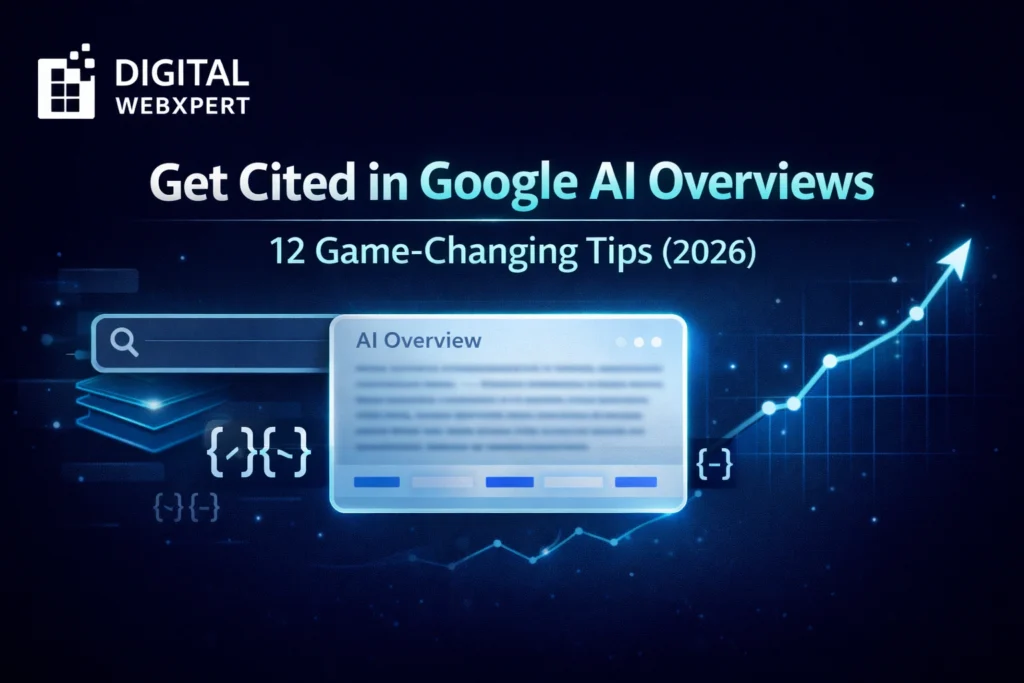
Getting cited in Google AI Overviews is quickly becoming the new “page one.” As Google pushes more answer-first experiences into Search, visibility isn’t only about blue-link rankings—it’s about being one of the sources AI chooses to reference.
Here’s the good news: Google has stated there are no special optimizations required to appear in AI Overviews—strong SEO fundamentals still matter most. But that also means your best advantage comes from making those fundamentals easier for AI to extract, understand, and trust. Google’s AI features guidance is clear: focus on technical eligibility, helpful people-first content, internal linking, and good page experience.
In this guide, you’ll learn 12 proven, game-changing tactics to improve your chances of being cited in AI Overviews in 2026—without keyword stuffing or gimmicks.
Recommended internal read: If you’re building a broader AI visibility strategy, start here:
How to Rank Higher on Google AI Search, ChatGPT, and Perplexity in 2025.
What Are Google AI Overviews (and Why Citations Matter)?
AI Overviews are AI-generated snapshots that summarize information and include links to supporting websites—helping users explore the web more efficiently. Google describes them as a way to get the “gist” quickly, with links to learn more. Source | Support info
Citations matter because they:
- Put your brand inside the answer (high-intent visibility)
- Drive qualified clicks from users who want details beyond the summary
- Build trust faster than generic rankings (you’re shown as a reference)
AI Overviews are also expanding globally—Google states availability across many countries and languages—so the citation opportunity continues to grow.
Learn more
How to Get Cited in Google AI Overviews: The 12 Proven Tactics
1) Make Sure You’re Eligible: Indexing + Snippets
This sounds basic, but it’s the foundation: to be shown as a supporting link, your page must be indexed and eligible to appear in Google Search with a snippet. Google says there are no additional technical requirements beyond standard Search eligibility.
Google documentation
Quick checks:
- Confirm indexing in Google Search Console
- Ensure robots.txt isn’t blocking key sections
- Fix 404s and redirect chains
- Make important content available as text (not only images)
2) Add a 40–70 Word “Answer Block” Near the Top
If you want AI to cite you, don’t force it to hunt. Place a clean, direct answer in the first 10% of the page.
Answer Block template:
What it is: one-sentence definition
Who it’s for: one sentence
Why it matters: one sentence (outcome)
Example (use/adapt):
Getting cited in Google AI Overviews means your page is selected as a supporting source for AI-generated summaries. To increase citation chances, publish clear answers, support claims with credible references, and structure content so Google can extract key points confidently.
3) Turn Keywords Into Questions (Then Answer Them Fast)
AI Overviews often trigger on complex, multi-part queries. Build your outline from real questions:
- “What is X?”
- “How does X work?”
- “X vs Y: which is better?”
- “Best way to…”
Pro tip: Make each H2/H3 a question and answer it in the first 1–2 sentences before expanding.
4) Use “Extraction-Friendly” Formatting (AI Loves Clean Structure)
Help Google extract content accurately:
- Short paragraphs (2–4 lines)
- Bullet lists with clear labels
- Numbered steps for processes
- Definitions that don’t rely on fluff
Google specifically calls out ensuring content is available in textual form, supported with quality images/videos where relevant, and backed by good page experience.
Google guidance
5) Build “Topic Clusters” with Smart Internal Links
Google recommends making content easily findable via internal links. Strong internal linking also builds topical depth—helping your site look like a reliable hub.
Google guidance
Internal links to add in this post:
- AI Search Optimization (Google AI + ChatGPT + Perplexity)
- Top 5 Ways to Prepare for the Google AI Search Revolution
- Digital WebXpert Services
- Contact Digital WebXpert
6) Cite Credible Sources (So Your Claims Look “Safe” to Reuse)
AI Overviews favor content that appears verifiable. Whenever you make a statistic claim, reference an authoritative source (Google docs, reputable industry research, recognized publications).
Best practice: Add 3–8 outbound references on long-form guides—especially on definitions, eligibility, and technical claims.
Useful references you can safely link:
- AI features and your website (Google Search Central)
- AI Overviews support page
- Intro to structured data
7) Use Schema Markup (But Match Visible Content Exactly)
Schema doesn’t guarantee citations, but it reduces ambiguity and improves machine understanding—especially for FAQs, how-tos, and definitions.
Recommended schema for this post: Article + FAQPage
Google also emphasizes that structured data should match the visible text on the page.
Google guidance
Schema tools: Test with Google’s Rich Results Test.
8) Strengthen Entity Signals (Brand + Author + About)
AI systems rely on entity understanding: who wrote this, what brand is behind it, and whether it’s trustworthy.
- Add an author bio with relevant experience
- Link to your About page: About Digital WebXpert
- Keep NAP/contact consistent across site
- Use real examples (screenshots, mini case studies)
9) Answer Comparisons Like a Product Reviewer (Even for Services)
AI Mode/Overviews often show on “compare” queries. Google notes AI Mode is useful for comparisons and deeper exploration.
Google guidance
Add a comparison block:
- Option A: best for…
- Option B: best for…
- Decision rule: choose A when…, choose B when…
This structure is easy to extract and cite.
10) Upgrade Your Media: One Custom Visual + Descriptive Alt Text
High-quality images and videos can support your content and improve page experience—both are called out by Google as worthwhile best practices.
Google guidance
Image SEO checklist:
- Use a descriptive filename
- Include the focus keyword in alt text (naturally)
- Compress for speed
- Place near the most relevant section
Note: Your featured image for this post should include the DIGITAL WEBXPERT logo in the top-left with safe padding (your brand standard).
11) Improve Page Experience (Because “Citable” Still Needs to Be Usable)
If your page is slow, cluttered, or ad-heavy, users bounce—and that weakens your overall performance signals.
Priorities:
- Fast load + mobile-first layout
- Readable typography and spacing
- Clear sections and jump links (optional)
- Minimal intrusive popups
12) Track AI Overview Visibility the Right Way (Not Just Rankings)
Google states AI feature traffic is included in Search Console performance reporting under the “Web” search type.
Google documentation
What to track weekly:
- Search Console: question queries + CTR shifts
- Pages with rising impressions but flat clicks (optimize answer blocks)
- Featured snippet ownership (often correlates with “answer-ready” formatting)
- Lead attribution (AI visibility can assist conversions)
Simple workflow: Each month, refresh your top 5 “answer” pages with updated stats, clearer headings, and 1–2 new FAQs.
Quick Checklist: “Citation-Ready Page” in 60 Seconds
- ✅ Indexed + snippet-eligible
- ✅ Answer block in first 10%
- ✅ Question-based headings (H2/H3)
- ✅ Lists/steps/comparisons for extraction
- ✅ 3–8 credible outbound references
- ✅ Internal links to related cluster pages
- ✅ Article + FAQ schema (matches visible text)
- ✅ Strong entity signals (author/about/contact)
- ✅ Fast, mobile-friendly UX
FAQ: Getting Cited in Google AI Overviews
Do I need special SEO to appear in AI Overviews?
No. Google says there are no special optimizations required; follow foundational SEO best practices, ensure technical eligibility, and publish helpful, reliable content.
Source
What content format gets cited most often?
Clear definitions, short direct answers, step-by-step lists, and comparisons—especially when backed by credible references and structured headings.
Does schema guarantee citations?
No, but it helps search systems interpret your page. Use schema only when it matches visible content, and test it with Google’s tools.
How can Digital WebXpert help with AI Overviews visibility?
We build AI-ready content structures, internal link clusters, schema implementations, and performance-focused pages designed to earn trust and citations.
Book a free consultation.
Final Takeaway
If you want to get cited in Google AI Overviews in 2026, don’t chase tricks. Build pages that are easy to extract, hard to misinterpret, and clearly trustworthy. Do that consistently across a topic cluster, and your brand becomes the “safe source” Google can reference again and again.