AI is no longer a “nice-to-have” in SEO—it’s becoming a competitive requirement. As Google’s algorithms get smarter and search behavior continues to evolve, marketers who rely only on traditional SEO methods will struggle to keep up.
The real winners in 2026 will be those who know how to use AI SEO tools strategically, not blindly.
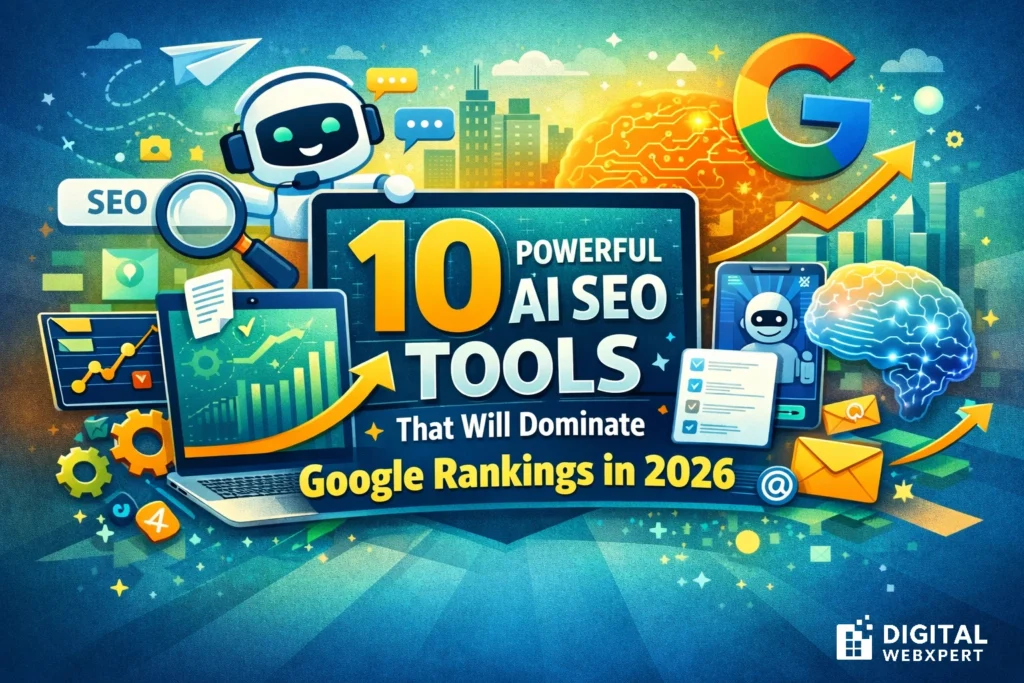
From smarter keyword research and content optimization to technical SEO and performance tracking, AI-powered tools are reshaping how SEO is done. In this guide, we’ll break down 10 powerful AI SEO tools that are expected to dominate Google rankings in 2026, explaining what they do, why they matter, and how to use them effectively.
Whether you’re a business owner, marketer, or SEO professional, this list will help you future-proof your SEO strategy.
Why AI SEO Tools Matter More Than Ever in 2026
Google’s focus has shifted heavily toward:
- Search intent and context
- Content quality and usefulness
- EEAT (Experience, Expertise, Authority, Trust)
- User engagement and satisfaction
AI SEO tools help marketers adapt by:
- Processing large datasets faster
- Identifying patterns humans miss
- Automating repetitive SEO tasks
- Improving decision-making with predictive insights
However, AI tools don’t replace SEO expertise—they amplify it. The tools listed below are the ones shaping the future of search.
1. ChatGPT – AI-Powered SEO Assistant for Content & Strategy
ChatGPT
ChatGPT has become one of the most widely used AI tools in marketing—and its role in SEO will only grow stronger in 2026.
Why ChatGPT Dominates SEO Workflows
ChatGPT helps with:
- Keyword ideation and clustering
- SEO content drafting and structuring
- Meta titles and descriptions
- Content refresh and expansion
- SEO strategy brainstorming
When used correctly, ChatGPT significantly reduces content production time while maintaining quality.
Best Use Case
Use ChatGPT as a content and strategy assistant, not an auto-publisher. Always edit, add expertise, and validate SEO decisions with data.
2. Semrush – AI-Driven SEO & Competitive Intelligence
Semrush
Semrush has evolved far beyond a keyword research tool. Its AI-powered features make it one of the most powerful SEO platforms heading into 2026.
Key AI Capabilities
- Keyword intent analysis
- Competitive gap analysis
- AI writing assistant
- SEO content optimization suggestions
- Predictive keyword trends
Why It Matters
Semrush combines human-readable insights with AI-driven data, making it easier to prioritize what actually moves rankings.
3. Ahrefs – AI-Enhanced Link Building & SEO Analysis
Ahrefs
Ahrefs remains a powerhouse for backlinks and technical SEO, and its AI-powered features are becoming increasingly valuable.
AI SEO Strengths
- Link opportunity analysis
- Content gap discovery
- Keyword difficulty modeling
- SERP movement tracking
Best Use Case
Ideal for SEO professionals focused on authority building, competitor analysis, and long-term ranking growth.
4. Surfer SEO – AI Content Optimization for Rankings
Surfer SEO
Surfer SEO uses AI to analyze top-ranking pages and provide data-backed content recommendations.
What Makes Surfer SEO Powerful
- NLP-based content analysis
- Keyword frequency recommendations
- Content score tracking
- SERP-based optimization guidelines
Why It Will Dominate in 2026
As Google becomes more context-driven, Surfer’s data-backed optimization helps content match real search intent, not guesswork.
5. Clearscope – AI Content Quality & Relevance Optimization
Clearscope
Clearscope focuses heavily on content relevance and topical depth, which aligns perfectly with Google’s Helpful Content updates.
Key Benefits
- AI-driven keyword suggestions
- Content grading system
- Topic coverage analysis
- Editorial-friendly interface
Best Use Case
Clearscope is excellent for teams producing high-quality editorial or long-form SEO content.
6. MarketMuse – AI for Topical Authority & Content Strategy
MarketMuse
MarketMuse uses AI to help brands build topical authority instead of isolated blog posts.
Why MarketMuse Stands Out
- Content gap analysis
- Topic authority modeling
- Internal linking suggestions
- Long-term content planning
SEO Advantage
Google rewards topical authority, and MarketMuse helps you build it strategically and consistently.
7. Frase – AI SEO Content Research & Answer Optimization
Frase
Frase is designed to help content creators answer search queries more effectively.
How Frase Helps SEO
- SERP-based content briefs
- Question and FAQ extraction
- AI-generated outlines
- Content optimization scoring
Best Use Case
Frase is ideal for optimizing content for featured snippets, FAQs, and voice search.
8. Screaming Frog + AI Integrations – Smarter Technical SEO
Screaming Frog
Screaming Frog remains a technical SEO favorite—and when paired with AI integrations, it becomes even more powerful.
AI-Enhanced Technical SEO
- Automated issue prioritization
- Pattern detection in crawl data
- Faster audits for large websites
- Smarter recommendations for fixes
Why It’s Future-Proof
Technical SEO is becoming more complex, and AI-assisted crawling helps SEOs focus on impactful fixes instead of raw data.
9. Rank Math – AI SEO Optimization Inside WordPress
Rank Math
Rank Math has integrated AI directly into on-page SEO workflows, making it a powerful tool for WordPress users.
AI SEO Features
- AI content suggestions
- SEO score improvements
- Schema automation
- Keyword optimization guidance
Best Use Case
Perfect for bloggers, businesses, and agencies using WordPress who want AI-powered SEO without complexity.
10. Google Search Console + AI Analysis Tools
While Google Search Console itself isn’t fully AI-driven, pairing it with AI analysis tools makes it incredibly powerful.
AI Use Cases
- Predicting ranking drops
- Identifying content decay
- Query intent analysis
- Performance anomaly detection
Why It Matters
First-party data from Google combined with AI insights offers the most reliable SEO decision-making foundation.
Common Mistakes When Using AI SEO Tools
❌ Relying only on AI without strategy
❌ Over-optimizing content
❌ Ignoring human expertise and experience
❌ Using too many tools without focus
❌ Blindly following AI recommendations
AI tools should guide decisions—not make them for you.
Best Practices for Using AI SEO Tools in 2026
✔ Choose tools based on goals, not hype
✔ Combine multiple tools strategically
✔ Validate AI insights with real data
✔ Focus on user experience and value
✔ Update content regularly
✔ Align AI usage with Google’s Helpful Content guidelines
The most successful SEO strategies blend AI efficiency with human judgment.
Final Thoughts: AI SEO Tools Are the Future—Strategy Is the Advantage
AI SEO tools will absolutely dominate rankings in 2026—but tools alone won’t guarantee success.
The real advantage comes from:
- Knowing which tools to use
- Understanding how to interpret insights
- Applying SEO fundamentals consistently
- Focusing on long-term value, not shortcuts
Marketers who master AI-assisted SEO today will be the ones leading search results tomorrow.
❓ Frequently Asked Questions (FAQ)
What are AI SEO tools?
AI SEO tools are software platforms that use artificial intelligence and machine learning to improve search engine optimization tasks. These tools help with keyword research, content optimization, technical SEO analysis, competitor research, and performance tracking by analyzing large amounts of data faster and more accurately than manual methods.
Will AI SEO tools really dominate Google rankings in 2026?
AI SEO tools are expected to play a major role in SEO success in 2026 because Google’s algorithms are becoming more context-aware, intent-driven, and data-focused. While AI tools alone won’t guarantee rankings, marketers who use them strategically will have a strong competitive advantage.
Can AI SEO tools replace SEO professionals?
No, AI SEO tools cannot replace SEO professionals. They are designed to assist with research, automation, and insights, but human expertise is still required for strategy, creativity, decision-making, and aligning SEO with business goals.
Is it safe to use AI tools for SEO according to Google guidelines?
Yes, it is safe to use AI SEO tools as long as the content and optimizations focus on quality, originality, and user value. Google does not penalize AI-generated content by default—it evaluates content based on usefulness, relevance, and trustworthiness.
Which AI SEO tool is best for beginners?
For beginners, tools like Rank Math and ChatGPT are excellent starting points. They are user-friendly, provide guided suggestions, and don’t require advanced technical knowledge to get results.
Which AI SEO tool is best for advanced SEO professionals?
Advanced SEO professionals often benefit from tools like Semrush, Ahrefs, and MarketMuse, which offer deep data analysis, competitive insights, and long-term strategy planning.
Do AI SEO tools help with content optimization?
Yes, many AI SEO tools help optimize content by analyzing top-ranking pages, suggesting relevant keywords, improving topical coverage, and aligning content with search intent. Tools like Surfer SEO, Clearscope, and Frase are especially effective for content optimization.
How many AI SEO tools should I use at once?
It’s best to use a small set of AI SEO tools that serve different purposes, such as one for content optimization, one for keyword research, and one for technical SEO. Using too many tools can lead to confusion and inconsistent strategies.
Are AI SEO tools suitable for small businesses?
Yes, AI SEO tools are very useful for small businesses because they reduce manual effort and help achieve better results with limited resources. Many tools offer affordable plans and simplify complex SEO tasks.
How often should I update my SEO strategy using AI tools?
You should review and update your SEO strategy regularly—at least every few months—using AI tools to track performance, identify content decay, and adapt to changing search trends. Continuous optimization is key to long-term rankings.
What is the biggest mistake people make with AI SEO tools?
The biggest mistake is relying entirely on AI recommendations without applying human judgment. AI tools should guide decisions, not replace strategy, experience, and critical thinking.